Building the “Gas Stations in Space”

Orbit Fab is building the infrastructure that allows satellites and spacecraft to refuel in orbit — replacing today’s disposable spacecraft model with a refuelable, reusable space economy.

The company already has hardware in space, $40M+ in commercial contracts and government awards, and backing from two of the largest aerospace and defense companies in the world: Lockheed Martin and Northrop Grumman.

‍

Full offering details are available to verified Hypervestor investors.

Stage

Series A+

Instrument

Equity

Minimum

$1,000

Notable Investors

Lockheed Martin, Northrop Grumman,
8090 Partners, Marubeni

The Problem

A $200M spacecraft can become useless simply because it runs out of fuel.

Today, satellites are launched with nearly all of the fuel they will ever have.

Once that fuel runs out, the spacecraft loses its ability to maintain orbit, reposition itself, avoid debris, or continue its mission — even when the rest of the hardware remains perfectly functional.

It is the equivalent of throwing away a $200M car because the gas tank is empty.

More than $10B of orbital assets are lost every year, while spacecraft designers are forced to devote valuable mass and space to carrying enough fuel for an entire mission from day one.

And as thousands of new commercial and defense satellites enter orbit, the problem only gets larger.

The Solution

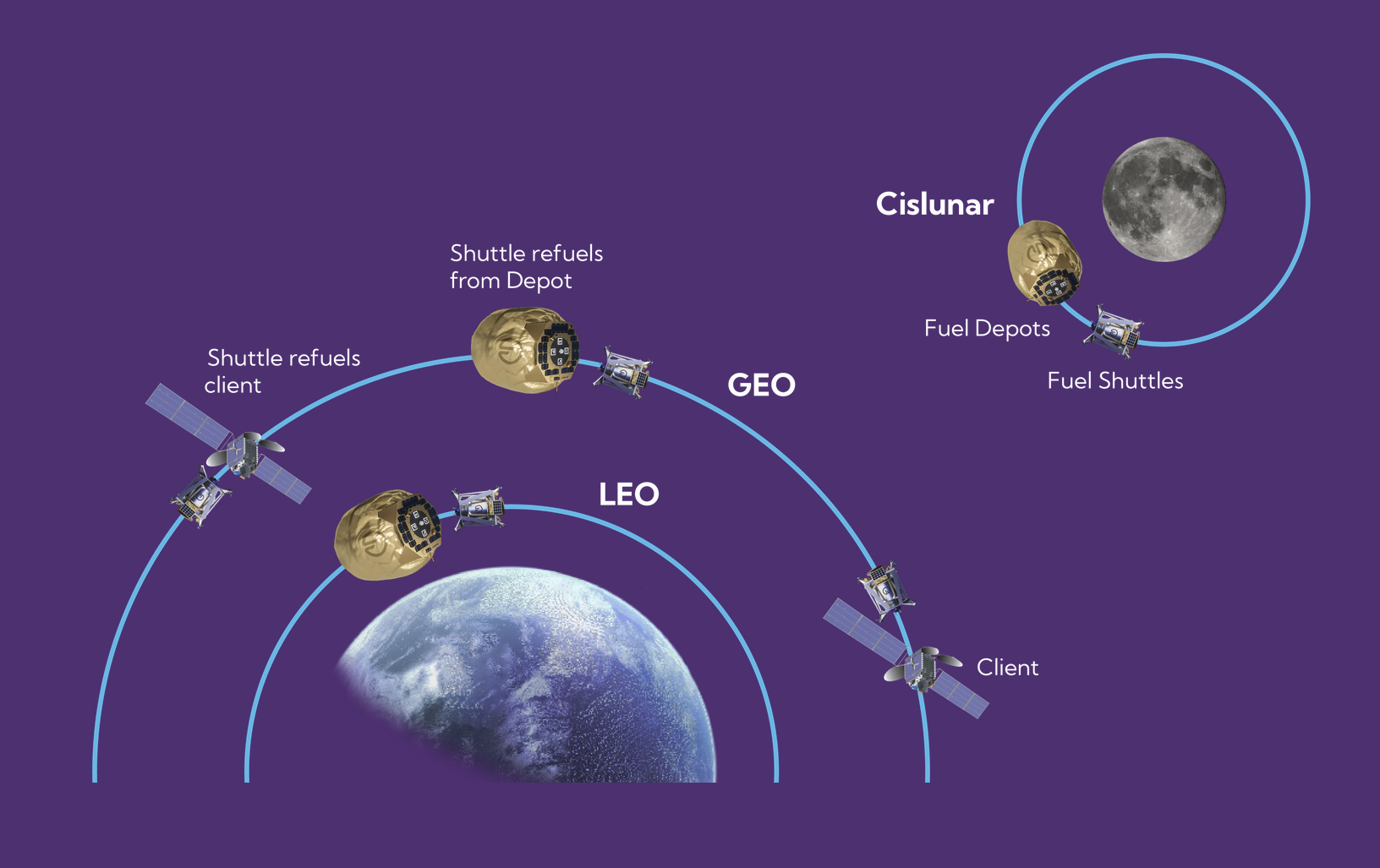
Orbit Fab is building the world’s first & only scalable fuel supply chain in space.

Orbit Fab is enabling satellites to refuel and extend their operating lives in space, much like airplanes, ships, and vehicles already do on Earth.

Instead of designing every spacecraft around a fixed amount of fuel, operators can build around a future where fuel is available after launch.

This changes the architecture of space entirely.

Longer satellite lifetimes are only the beginning. In-orbit fuel can support orbital transportation, satellite servicing, debris collection, commercial space stations, in-space manufacturing, and eventually deep-space missions.

‍

RAFTI — the fueling port

Orbit Fab's Rapidly Attachable Fluid Transfer Interface (RAFTI) is a standardized fueling port installed directly onto spacecraft.

‍

GRIP — the robotic connection

Orbit Fab's Grappling and Refueling Interface Port (GRIP) is the robotic nozzle that connects with RAFTI and transfers fuel between spacecraft.

Together, RAFTI and GRIP create a standardized way for spacecraft to connect and refuel autonomously in orbit.

‍

Depots + Shuttles — the distribution network

Orbit Fab is building fuel depots to store propellant in orbit and reusable fuel shuttles capable of transporting that fuel to customer spacecraft.

‍

Why Invest

Orbit Fab is establishing the refueling standard for the Space Economy.

Every spacecraft launched with RAFTI becomes a potential future customer for Orbit Fab's fuel.

The company estimates that each RAFTI port could generate more than $42M in lifetime fuel demand.

RAFTI is already being adopted by commercial operators and propulsion manufacturers and is referenced in upcoming U.S. government programs.

It is also the only commercially available refueling interface approved for U.S. defense satellites.

The more spacecraft launched with RAFTI, the more destinations exist for Orbit Fab's fuel shuttles.

The more fuel shuttles and depots Orbit Fab deploys, the more useful RAFTI becomes to spacecraft operators.

And every kilogram of fuel transferred through that network represents another potential transaction.

‍

The economics of delivering fuel to orbit are mouth-watering.

Orbit Fab can purchase propellant on Earth for roughly $300 per kilogram.

Once delivered into orbit, that same fuel can be worth approximately $200,000 per kilogram.

That enormous difference exists because getting fuel to the right spacecraft, at the right orbit, and transferring it safely is extraordinarily difficult.

Orbit Fab is building the infrastructure required to do exactly that.

‍

Refueling can expand the market far beyond extending satellite life.

The immediate use case is straightforward: keep expensive satellites operating longer.

But once fuel is reliably available in orbit, spacecraft no longer need to be designed as disposable machines carrying their entire lifetime fuel supply from Earth.

That opens the door to smaller fuel tanks, more room for payloads, longer missions, and entirely new businesses that are difficult to build without reliable access to propellant.

Orbital transportation, satellite servicing, debris removal, commercial space stations, in-space manufacturing, and deep-space logistics all become more practical when spacecraft can refuel.

If Orbit Fab becomes the infrastructure layer supplying that fuel, its market grows alongside the space economy itself.


The Team

Daniel Faber

FOUNDER

15+ years of space technology and startup leadership. Most recently the CEO of Deep Space Industries.

Peter Shaper

CEO

More than three decades of experience leading and scaling private equity-backed companies through periods of rapid growth, operational transformation, and market expansion.

Shawn Hendricks

COO

Experienced Leader in $100M+ high technology production environment. Strong background in Program Management, Production, Systems Engineering and Integration and Test of multi-domain systems.